
This week, I come to you with some useful(less) information about Brindle Labs- something I only recently discovered exists.
How did I come by this information?

I know, I know. Puppies. Santa Hat. The smile on that pups face. Are you melting?? If you aren’t, are you human?
Now focus a little closer and look at the paws on these pups. Wait! Black lab in the face, something else on the paws. Yes, I know the next question- and yes, they are pure bred Labrador Retrievers. In today’s post I explore a bit about Labrador genetics and how two parents who never showed any signs of discoloration came out with 3 brindle labs.
DID YOU KNOW?
The Labrador Retriever, according to the American Kennel Club is ranked #1 in popularity out of 193 breeds. They are sporty, friendly, social, and most commonly referred to as the top of the line when it comes to family pets. With their amazingly soft ears and what looks like a never ending smile – how can you not like them?
According to the AKC there are only 3 permissible colors to a Labrador Retriever.
As stated on the AKC site:
As a biologist, this absolutely intrigues me. If only the 3 colors are permissible, then what is a brindle lab? To answer this question, let us first lets looks at what makes Lab coloring.
Unlike what you might think, Lab coloration is not based on just one gene. I had always assumed that black = dominant and chocolate = recessive with Yellow being the combination of a dominant and recessive gene (and I’m a biology teacher – oops). It is actually the result of two different genes, one coding for Black and Chocolate and a separate gene coding for yellow. These are referred to as the B gene and the E gene.
Before your eyes glaze over (like my husbands did), here is a visual graphic to help bring home the basics.

The basics of this image shows that if the dog has at least 1 B and no ee, it will always be black. If the dog has ee, regardless of the B gene, it will always be yellow. And if the dog has bb (two copies of the recessive b) it will be chocolate (unless in the presence of ee). This is why chocolate is the least common, due to the fact that it cannot have a B or ee in order to show this trait. Black is most common, because all the dog needs is 1 B and at least 1 E and it is black. Though the presence of two recessive ee will beat out any combo and make the lab yellow.
So what is brindle?
Brindle is defined as : a brownish or tawny color of animal fur, with streaks of other color. It is fairly common in breeds, such as Boxers, but incredibly rare in pure bred Labs.
My first example of this cool coloration comes from our newest addition to the family, Rosalee a.k.a. Rosie. My little girl was 1 of 3 brindle labs to come out of her litter.
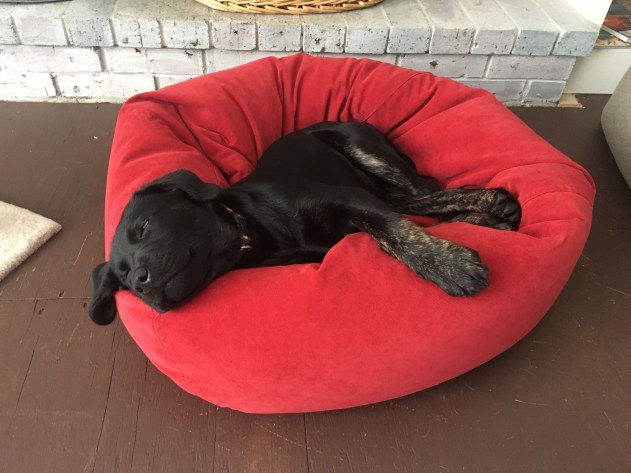


This is Rosie’s twin sister, Luna. Check out her beautiful brindle coloration, she has slightly more golden colored fur on her left paw.
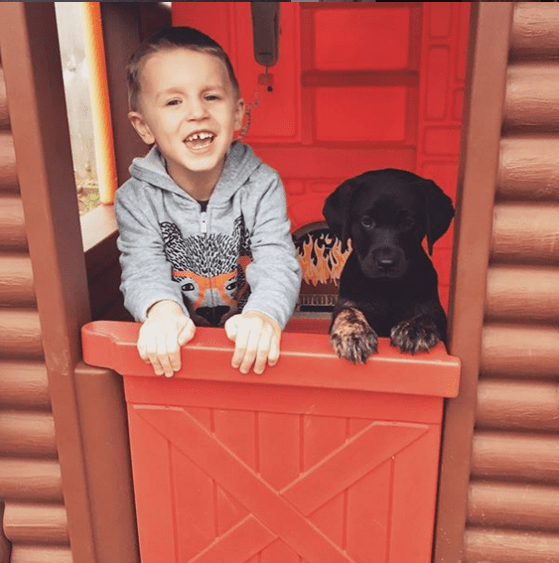


So are brindle labs pure bred?
The simple answer is YES. Although, even our vet had assumed that there must be a mix of something in there. Most people, like me, have never seen a pure bred brindle Lab. When you see a pure bred Labrador Retriever, most think of solid coloration. The mixed color of a brindle can often be confusing. But lets take a look at our girls parents:


Mom, is a pure-bred black Lab (left image) and Dad is pure-bred yellow Lab (right picture)
These two have mated before. Their previous litter consisted of 8 pups: 4 black, 3 yellow, and one chocolate. Looking at that in genetic terms, we know that Dad has the ee gene making him yellow, but also that he must carry at least 1 b gene. Mom must carry at least 1 e gene, to make yellow pups, and 1 b gene creating the 1 chocolate pup. So, the nerdy biologist in me knows that the parents are most likely – Dad eeBb x Mom EeBb.

But, this still doesn’t explain brindle. So what gene is responsible for that?
This is actually due to another gene, not the standard B and E genes that we think about when predicting lab coat color.
“[More commonly], a litter may show up with a surprise pup or two that are either tan point like a Doberman or a Rottweiler, the same pattern with brindle in the points, or even brindle all over.” www.vetgen.com .
What we have learned is that this gene is actually at the K locus. For most labs their K gene is dominant, which is why we note most labs as solid colors. In the case of brindle labs, they have the recessive version of the K gene, known as kbr. Approximately 1/25 of pure bred Labs have this recessive trait. These genes are so rare to show up in the litter because the K is completely dominant over the kbr. Meaning that the only way for brindle to show is if both parents donate a recessive, meaning the pup has a kbr from both parents. If you have two dogs with a copy of the recessive you should see 1/4 of the dogs will not be purely one color. As in our case, after a litter of all solid color pups, the second mating between these parents the recessive K gene was passed on by both parents creating 3/10 with the recessive trait and therefore brindle. As you can tell, this makes it very hard for any breeder to know the likelihood of brindle pups.
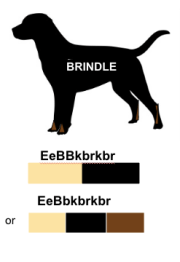
Has this gene always been a part of pure-bred Labs?
Again, the simple answer is yes. Labrador Retrievers were first recognized by the English Kennel Club in 1903, and later in the U.S. in 1917. The majority of Labs in the beginning were black, with yellow being the less frequent color. Chocolate Labs weren’t recognized by the AKC until the 1930’s, probably due to their recessive inheritance pattern.
According to vetgen.com:
“Historically, the brindle and tan point variations have been noted since the inception of the breed. They have always been there, simply at a very low frequency.”
The brindle coloration, although not recognized as a color by the AKC, has been around since the beginning of the breed. Making it a little confusing why they do not recognize it as they did when the chocolate coloration came about, since it is just a matter of recessive genes being passed down.
Are brindle labs desirable?
Obviously this is a matter of preference. Some breeders may use the uniqueness of the coat color to charge more for dogs like this. It could even be something that they breed for if demand for unique Labs is up. I had never heard of brindle before picking out my Rosie. We were planning on getting a yellow until my kids saw pups with brown feet and they were in love. For us, we thought they were so different and embraced that.
The AKC does not permit brindle coloration, making me believe the majority of breeders do not prefer this in their litters. Many might even give a discount for pups that do not come out with solid coloration and cannot be pedigree dogs.
I guess it is all comes down to a matter of preference.
I hope you have learned a lot about the genetics of Labrador’s coat colors and enjoyed images of my families’ adorable pups.
Do you have a brindle Lab? Leave a pic in the comments of your brindle, tan point, or unique colored pooch.


 Three Monkies Farm
I have a picture of our brindle to send but I can’t post for some reason. I also had never heard of this coloring and had intended to get a yellow lab until we saw this roly poly cutie with special coloring on his paws. We love his coloring and wouldn’t change him.
LikeLike
Isn’t that funny!! We were set to get a yellow too!!
LikeLike
This is my sweet girl Nori. She is my service dog and incredible in all ways. She has produced 16 pups who were all solid black or yellow (We picked a stud who had genetic testing for coat), and 6 of those are currently working service dogs themselves. I know the AKC isn’t a fan of the brindle lab but I definitely am!
LikeLike
Cant get my photo to post either ! We were looking for a lab puppy after our springer spaniel passed away. We had a yellow lab that was our first pet so we really wanted a lab again! We love our brindle lab, Bear
LikeLike
We have a brindle lab, he’s so beautiful! We picked him up 2 weeks ago. So smart, so unique and so perfect! His Instagram is @onzothelab if you want to check him out! X
LikeLike
OMG, he’s sooo cute and he looks so much like my Rosie!!!
LikeLike
https://share.icloud.com/photos/0qStGaKxH42VLVIAb5MCiSTJA#Monticello
Not sure if this links to a photo of Miss Olive or not, but she is one of 4 (out of a litter of 12) who had brindle markings, Olive is the most marked with all of her points affected (and rather large points to boot). I also had never heard of this before and as this was my litter I was flabbergasted lol.
LikeLike
I have a brindle female Lab and am interested in locating others, particularly males who carry brindle, have had health testing (hips, elbows, etc.) and are available to breed. This is trickier than one might guess, as nearly all DNA laboratories cannot test for the brindle gene, so unless a parent of a litter with brindle pups actually shows brindle, there is no way to know which parent carries it and which parent carries the recessive ky gene necessary for a pup with a copy of the brindle gene to show brindle. Do you have a male available? Or do you plan to repeat the breeding?
LikeLike
Hi Brian I have a female. What part of the country are you located in?
LikeLike
Hi Erin, I am in Virginia but travel a lot. Distance is no obstacle.
LikeLike
I’m about to adopt a brindle labrador, I looked a lot here in Brazil for information about the brindle labrador and I didn’t find anything, I’m very happy to find this page here with so much information and people happy to have a brindle dog.
Brazil kisses for you!!
LikeLike
I am so happy to hear this!! It is hard to find info on them!!! Congrats on your new pup!
LikeLike
I just had a litter and one has brindle on her legs. She’s adorable but I will not keep for breeding obviously. I was going to post a picture but can’t figure out how. Lol
LikeLike
I’m not sure how to post pictures either!
LikeLike
I love my brindle girl! She’s absolutely gorgeous! My Breezy girl 😊 wish I could post her picture
LikeLike
I wish I knew how to let you post her picture. I can’t figure it out!
LikeLike
My Jupiter isn’t a purebred lab, but he’s a lab/basset hound cross and I believe his brindle coloring must come from the lab side, as I can’t find any info about brindle showing up in purebred basset hounds. He looks so much like the puppies in the photos here, too! Try this link for a picture: https://i.imgur.com/cP5Luhp.png Hope it works!
LikeLike
Oh my goodness, he is sooo cute! He definitely looks like all of the brindle labs I’ve seen!
LikeLike
I have an 11 month old brindle lab that looks alot like your Rosie. The vets here in NZ doubted his pedigree so this info youve provided is great. I can now explain his colouring with confidence.
LikeLike
That’s awesome! I’m so glad it cleared it up! Its so cool!
LikeLike
We were surprised to discover our purebred labs we breed giving some brindle labrador pups! Glad to find more information on this as I was quite confused
LikeLike
I’m glad it was helpful! I can tell you I get soooo many people asking where they can find a brindle lab. Our breeder isn’t breeding anymore so I never know where to send them! You should get lots of interest in those pups!!!
LikeLike
I’m glad you found it helpful!!
LikeLike
anyone know of a reputable breeder that has brindle labs? I had adopted one from a shelter years ago but unfortunately he passed away from cancer this last year. Best dog ever!
LikeLike
Sorry to hear this. I don’t currently know anyone.
LikeLike
Hi
My yellow female lab had a litter of 12 puppies (8 black, 2 yellow, and 2 brown) the end of August 2024. The sire is a black lab. Three of the black males and the chocolate female have a brindle pattern on their legs.
There are two males with brindle available, if your interested.
Shelly
LikeLike
My baby and her sister were 2 of 12 puppies that had brindle markings. We named our girl Brynn (Brindle Marie if she’s in trouble lol) Her legs and paws are beautiful, especially in the summer. The breeder had never seen it before and told us exactly what you’re showing here, a recesssive gene bred out in purpose. She had a few more puppies from the same parents in a subsequent litter as well. Dad is yellow and Mom was chocolate and Miss Brynn is Black just like your beautiful babies. She just had her 8th birthday ❤️
LikeLike
Aww, I’m sure she is beautiful!!!
LikeLike
Thank you for educating me on the genetics of labs and their coloring! We had a black lab with brindle tan points, and we always wondered how that was possible. Wish I could post a picture of my Charlie!
LikeLike
My yellow female lab produced a litter of 12 puppies (8 black, 2 yellow, and 2 brown). The are was a black male. Three of the black males and the chocolate female have a brindle pattern on their legs.
So researching this I came to your page. Thanks for the explanation and pictures!
LikeLike
Awesome I’m so glad this was helpful!!!
LikeLiked by 1 person
My yellow female lab had a litter of 12 puppies (8 black, 2 yellow, and 2 brown). The sire is a black lab. Three of the black males and the chocolate female have a brindle pattern on their legs.
So researching this I came to your page. Thanks for the explanation and pictures!
LikeLike
Hi to all,
We have been fostering a black with gold brindle pup for a month, and have decided to keep his adorable self. We *think* he is a black Lab mix; he looks very much like your pups. He looks like he ran through a brindle fog.
His rescuers called him Bear, so we went with Baloo because he is a bit silly.
LikeLike